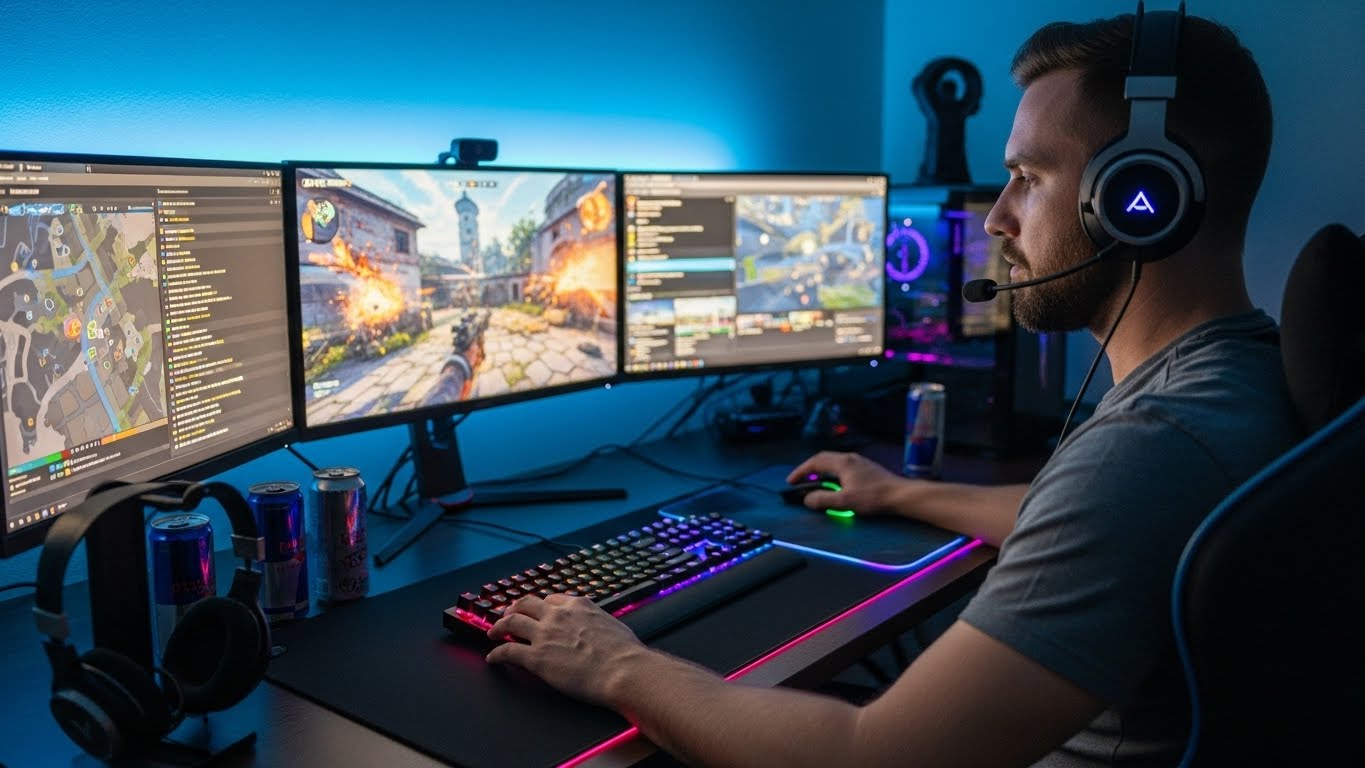
Gaming has transformed from a niche pastime into one of the most dominant cultural forces in the world. It has evolved from pixelated screens and simple beeps to sprawling universes filled with rich narratives, emotional depth, and lifelike visuals. For millions of people, gaming is not just entertainment; it is a passion, a community, and in many ways, a way of life. To understand how gaming became what it is today, one must explore its roots, its rise, and its ongoing evolution as both an art form and an industry.
The Birth of a Digital Dream
The story of gaming begins humbly, with blinking dots and primitive sound effects that captured human curiosity. In the 1950s and 60s, computer scientists and engineers began experimenting with interactive programs that could be “played.” One of the earliest examples, “Tennis for Two,” created in 1958, displayed two dots bouncing across a cathode-ray screen to simulate a tennis match. This seemingly simple experiment represented the birth of digital play.
By the 1970s, arcade machines began to appear, and gaming entered the public consciousness. Titles like “Pong,” “Space Invaders,” and “Asteroids” became household names, attracting crowds to arcades around the world. These machines stood as gateways into a new kind of experience — one that merged technology, competition, and imagination. The tactile sound of coins dropping into machines, the glow of CRT monitors, and the friendly rivalry among players all helped create the foundation of gaming culture.
The Rise of the Console Generation
The late 1970s and early 1980s saw the dawn of home gaming consoles. Companies like Atari, Nintendo, and later Sega brought the arcade into living rooms. With cartridges and controllers, families could now play together without leaving their homes. Games such as “Pac-Man,” “Donkey Kong,” and “Super Mario Bros.” became cultural landmarks, introducing characters who remain beloved icons today.
The 8-bit and 16-bit eras marked the start of what many call the golden age of gaming. These systems were not just about playing; they were about imagination. Players were transported to castles, galaxies, and dungeons, guided by the limitations of technology but fueled by boundless creativity. Despite simple graphics, these games offered challenge, mystery, and wonder. They demanded skill, timing, and patience — qualities that created lifelong fans.
From Pixels to Polygons
The 1990s brought a revolution that changed gaming forever: the transition from 2D to 3D graphics. Titles like “Super Mario 64,” “Tomb Raider,” and “The Legend of Zelda: Ocarina of Time” redefined what a video game could be. No longer restricted to side-scrolling screens, players could explore vast environments in three dimensions. The sense of freedom and immersion this offered was transformative.
At the same time, gaming began to develop richer stories and characters. Games like “Final Fantasy VII” demonstrated that gaming could evoke genuine emotion, telling stories of love, loss, and sacrifice. Developers realized that games could be more than high scores — they could be journeys of the soul.
The decade also saw the rise of PC gaming as a force to be reckoned with. Titles such as “Doom,” “Half-Life,” and “StarCraft” set new standards for technical innovation and storytelling. Online multiplayer features began to emerge, hinting at a connected future where players could compete or cooperate across the world.
The Birth of Online Worlds
When the internet reached homes in the late 1990s and early 2000s, gaming changed again. Players were no longer isolated; they became part of a global network of competitors and collaborators. Online games like “Counter-Strike,” “EverQuest,” and “World of Warcraft” allowed thousands of players to share the same virtual space, forming communities that extended beyond the screen.
These online worlds became second homes for many. Players built friendships, formed guilds, and developed identities that sometimes felt more real than their offline selves. The rise of online gaming also created entirely new forms of competition, giving birth to what we now call esports. Games like “StarCraft,” “Halo,” and “League of Legends” began hosting tournaments with massive audiences and prize pools, elevating gamers to the status of professional athletes.
The Modern Era: A Cinematic Universe
Today’s games rival Hollywood in scale, budget, and ambition. Titles like “The Last of Us,” “Red Dead Redemption 2,” and “Cyberpunk 2077” deliver cinematic experiences that blend storytelling, art, and interactivity into a single medium. Voice actors, composers, and motion-capture artists bring characters to life in ways that were unimaginable a few decades ago.
Modern consoles like the PlayStation 5, Xbox Series X, and powerful gaming PCs provide near-photorealistic graphics. Meanwhile, indie developers continue to push creativity in new directions with unique, emotionally resonant experiences such as “Undertale,” “Celeste,” and “Hollow Knight.” The industry has matured to a point where a game can make you laugh, cry, or question the world around you.
Streaming platforms have also reshaped how games are experienced. Services like Twitch and YouTube Gaming turned play into performance, and gamers into entertainers. Millions tune in daily to watch their favorite streamers play, comment, and interact. The line between playing and watching has blurred, creating a new entertainment ecosystem built entirely around interactivity.
The Culture of Gaming
Gaming is no longer confined to the screen. It influences fashion, music, art, and even language. Iconic phrases like “level up,” “respawn,” and “game over” have entered common speech. Music from game soundtracks is performed by orchestras worldwide. Characters once known only to gamers now appear in movies, advertisements, and cultural discussions.
At conventions like E3, PAX, and Gamescom, fans gather to celebrate their shared love for the medium. Cosplayers bring digital heroes to life, developers showcase new innovations, and players meet the people behind their favorite games. These events are proof that gaming is not a solitary hobby but a global community.
Gaming has also sparked serious discussions about representation and inclusivity. As the player base grows more diverse, so does the demand for stories that reflect different identities and experiences. Developers are now more conscious about creating inclusive worlds, breaking stereotypes, and embracing the idea that everyone belongs in gaming.
The Psychology of Play
Why do people love games so deeply? The answer lies in the psychology of play. Games satisfy fundamental human needs: the desire for challenge, mastery, connection, and escape. They provide a space where failure is not fatal but a stepping stone to success. In games, players can experiment, learn, and grow without real-world consequences.
This sense of control and progress can be incredibly empowering. For many, games offer a refuge from the unpredictability of life. They create worlds where actions have meaning, where effort is rewarded, and where one can explore aspects of identity otherwise hidden.
At the same time, gaming provides a sense of community. Cooperative games encourage teamwork and communication, while competitive ones test reflexes and strategy. Online friendships often transcend borders and languages, uniting people under a shared passion.
Gaming and the Art of Storytelling
In the past, storytelling was linear — a book, a film, a play. But games introduced interactivity to narrative. In a game, the player becomes part of the story, shaping its outcome through decisions and actions. This participation creates a unique emotional bond between player and world.
Games like “Mass Effect,” “The Witcher 3,” and “Detroit: Become Human” showcase the power of choice. Every dialogue, every moral decision alters the story, making each playthrough personal. This interactivity allows games to explore complex themes such as morality, free will, and consequence in ways that passive media cannot.
Even games without traditional narratives tell stories through environment and gameplay. The haunting ruins of “Dark Souls,” the quiet loneliness of “Journey,” or the eerie silence of “Inside” communicate emotion without words. In this sense, gaming has become one of the most expressive art forms of the modern age.
The Economics of the Industry
The gaming industry today generates more revenue than film and music combined. It is a multibillion-dollar global enterprise employing millions of people across development, marketing, esports, and content creation. But behind the numbers lies a complex ecosystem driven by passion and innovation.
The rise of mobile gaming expanded the market dramatically, making games accessible to people who never owned consoles or PCs. Titles like “Candy Crush,” “Clash of Clans,” and “Genshin Impact” attract hundreds of millions of players daily. This accessibility has democratized gaming, blurring the line between casual and hardcore audiences.
However, this growth also brings challenges. Microtransactions, loot boxes, and monetization models have sparked debates about ethics and player rights. Developers face the constant pressure to balance creativity with profit, to serve both shareholders and fans. Despite these tensions, the industry continues to thrive, adapting to new technologies and changing player expectations.
Virtual Reality, Augmented Reality, and the Future
The next frontier of gaming lies beyond the screen. Virtual reality (VR) and augmented reality (AR) are redefining immersion. With VR headsets, players can step directly into digital worlds, experiencing presence and depth unlike anything before. Games like “Half-Life: Alyx” and “Beat Saber” showcase the potential of VR as a transformative medium.
AR, on the other hand, brings the game into the real world. The success of “Pokémon GO” proved that blending reality with play could create entirely new social experiences. As technology advances, we may see AR integrated into everyday life, turning the world itself into a playground.
Artificial intelligence is also shaping the future of gaming. AI-driven characters that learn from players, procedural generation of worlds, and adaptive storytelling promise experiences that feel alive and unpredictable. The boundaries between player and developer, creator and consumer, are gradually fading.
The Social Impact of Gaming
Beyond entertainment, gaming has real-world influence. Educational games teach problem-solving and creativity. Simulations help train professionals from pilots to surgeons. Games are also used in therapy to treat anxiety, depression, and trauma, offering safe spaces for emotional exploration.
Charitable initiatives within gaming communities have raised millions for causes around the world. Events like charity streams, in-game fundraisers, and awareness campaigns show that gamers can be a force for good. Gaming has become a tool for empathy and connection, proving that digital play can have tangible benefits for humanity.
Yet, it is also important to acknowledge the challenges. Issues like addiction, toxicity, and online harassment remain serious concerns. Developers and communities are working to create safer, more inclusive spaces, recognizing that the health of gaming culture depends on respect and balance.
Gaming as Identity
For many, gaming is not just a hobby — it is a core part of who they are. The games people play often reflect their values, interests, and dreams. Whether someone is a competitive player seeking mastery or a casual gamer exploring new worlds, gaming becomes an expression of self.
In the digital age, identities formed through gaming can be as meaningful as those in the physical world. Players create avatars, build virtual homes, and form friendships that span continents. These experiences challenge traditional notions of community, proving that connection transcends geography.
Gaming also offers representation and belonging to those who feel marginalized in society. Within virtual worlds, players can exist free of judgment, choosing who they wish to be. The ability to craft identity, experiment with roles, and express creativity makes gaming a uniquely liberating medium.
The Endless Game
As technology continues to evolve, so too will gaming. From artificial intelligence to quantum computing, the future promises worlds we cannot yet imagine. But one truth remains constant: gaming will always be about the human need to play, to imagine, and to connect.
The medium’s journey from arcades to virtual reality is more than a story of machines; it is a story of people — of dreamers, innovators, and players who believe in the magic of interactivity. Gaming has become a mirror of society, reflecting both our progress and our imagination.
Ultimately, gaming is more than the sum of its pixels and code. It is a celebration of creativity, challenge, and community. It is a living art form, constantly changing, always growing. And as long as humans continue to dream, gaming will continue to evolve — not just as entertainment, but as a powerful expression of what it means to be alive.